The claim · agents cannot own level production
They said agents can’t design production-grade puzzle levels. Ours ship hundreds.
Not a copilot and not a level generator — a production loop that composes campaigns, simulates every candidate, reads the playthrough back, and improves the next batch without a designer reviewing every board. We build the loop; the studio ships the game.
~120 levels shipped and climbing · 90% acceptance · expert detection at chance
Start with the part you don’t believe
One system, three field reports. Pick the question that matters most to your studio — the whole engagement is written up as it happened.
Playable Was the Easy Part
The whole arc: a studio arrives with playable-but-flat levels from their own agentic workflow; a first review rejects three of four; the bar rises every time it's cleared — until a full campaign ships.
No Rulebook, No Tells
The blind test as engineering: caught 14 of 20 in twenty minutes, a physics model that was wrong twice, and the five days that took an expert's detection rate to a coin flip.
You Can’t Design What You Can’t Solve
The method: a level is art, play, progression, and product pressure at once — and the agent only improved when it stopped generating boards and started editing one, gate by gate.
The last manual bottleneck is the product itself
Before we built any of this we spoke to more than ten people who actually make mobile games — studio founders, level designers, product managers. They told us the same thing, in nearly the same words.
Everything around the game had gotten faster. Engineering had copilots. Art had generators. Marketing had more testing capacity than it knew what to do with. And level production — the one discipline that decides whether a player stays, churns, or pays — still scaled exactly the way it did before any of it: by adding people.
“AI might make designers 20% faster. It will never run level production.”
What we heard, repeatedly, before the engagement
Several of them had already tried pointing an agent at it. Every one of those attempts had stopped in the same place, and none of them believed the rest was possible.
We are not a game studio and have no ambition to become one. We are an AI infrastructure company. We build loops — and this was a domain where the loop did not exist yet.
Three disciplines accelerated, one untouched
Engineering
Copilots, tests, refactors, prototypes.
AcceleratedCreative
Concepts, variations, production assets.
AcceleratedMarketing
Ads, audiences, localization, testing.
AcceleratedLevel design
One designer. One board. One bottleneck.
Still manualA coding agent can design a level. That was never the question
Give an agent your tools, a brief, and a designer’s feedback and it will help with the next iteration. Useful — but the human is still the loop. You get roughly 20% more leverage for the same design team, not a new production model. The question is what stands between that and a system that owns the output.
Two ways to put an agent on level design
Agent inside the designer’s loop
~20%The agent drafts, the designer reviews, the agent revises.
A useful tool — and the same designer still sits in the critical path of every level.
Result · ~20% more output, same bottleneck.
Agent owns the production loop
~120Generate hundreds, continue the campaign’s flow, watch how players move through the funnel.
Turn that evidence into the next batch, at production scale.
Answer · yes, when the loop is engineered.
The job
A studio hand-crafts its levels because resistance is the product: a level has to be figured out, not just cleared. Their own LLM pipeline already produced levels that loaded, validated, and exported cleanly — and played flat. Every board slid apart in a few obvious moves.
Solvable is a floor, not a bar. The bar is a human expert who can't tell your levels from theirs.
That became the acceptance test, fixed before any engineering: shuffle 20 generated levels into 20 production levels and let the studio's own designer mark the machine's work. Success means his detection rate is statistically indistinguishable from guessing.
A board in the studio's own schema
board.json, loaded straight into the studio's editor.The loop, for this domain
Loop engineering means building the domain around the reasoning model. For level design that world is:
- Actions — edit tiles, place pieces and mechanics, export
board.jsonin the studio's own schema. - Instruments — a simulator that replays every candidate; feature extractors measuring each board against 100 production levels (solve length, symmetry, dead ends, opening pressure).
- Truth — certification gates with thresholds learned from the corpus, and behind them the blind test: a human expert trying to catch the machine.
The loop, keyed by stage
One revision through the loop
Every level has a job. The sequence is the design.
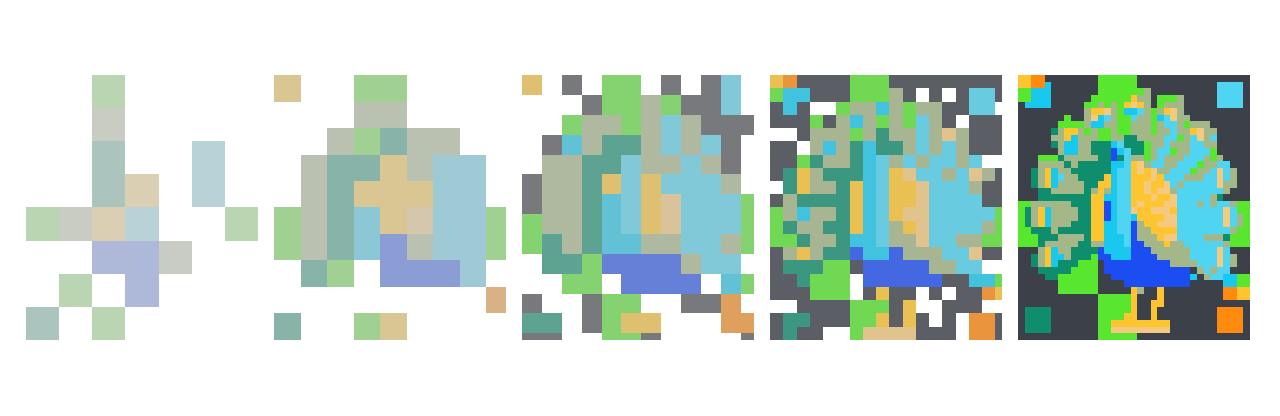
A production system does not emit a hundred disconnected boards. It gives each level a job, then makes that level do it — and the revisions are not a straight line. The peacock below is the clearest record we have of one level being made to do its job: five stages, four revisions, and two rejections that came from a human, not a gate.
Sparse, then generic, then rejected, then shipped

Deterministic conversion preserves the bird, the fanned tail, the eye spots and the dark negative space. No gameplay yet.

The board solves, but it is still an isolated sprite. Gameplay was added without building a composition around it.

Density reaches the corpus, but the regular border and flat fill make it a reusable template rather than a level-specific composition.

Four keys and locks create activity, but the mechanic competes with the subject and the composition reads as assembled rather than authored.

Mechanics move to the periphery, the bird stays dominant, and connected groups create pressure without hiding the image.
Then the campaign reads the players back
What happened
The engagement is written up in full in the three posts below; the short version spans three moves.
Deconstruct first, prompt later. Before generating anything, the agent's world was built by measuring the studio's hand — 100 production levels reduced to the features a designer feels but hadn't named. The first review still rejected three of four levels, and the physics model behind the simulator turned out to be a hypothesis that was wrong twice. Each miss became a gate.
The bar moves every time you clear it. Early wins exposed the next tell: levels that solved cleanly but sat outside the corpus on symmetry; art that read as noise; openings without pressure. The agent changed from a generator into an editor — revising one board repeatedly until art, play, progression, and product pressure told the same story. The peacock that finally shipped took five stages and four revisions.
Rejected until the subject read at a glance


Then the lineup. Round one, the designer caught 14 of 20 in twenty minutes. Round three, five days and three physics models later, his hit rate met his false-positive rate.
From caught to indistinguishable
Detection rate by round, against chance
screenshotsround 2
played in-engineround 3
played
Where generated levels sit inside the studio corpus
Can AI design good mobile game levels? Definitively, yes.
Can an agent design good mobile game levels? Definitively, yes — but not by generating one level and waiting for a designer to fix it.
What the engagement settled
The system plans a progression, generates and certifies against gates learned from the studio’s own corpus, observes what players do, and updates the next batch. The designer sets the intent; the loop carries it at scale.
The bottleneck was never the drafting. It was that “good” lived only in a person’s head.
What transferred
Level design was the domain; the discipline is portable. Three things we'd tell you to steal:
The loop-engineering takeaways
Fix the acceptance test first
A human expert trying to catch you bends every decision toward what he can see that you can't measure yet.
The simulator is the truth layer
Nothing ships on plausibility. When the physics model was wrong, the gates were wrong — so the physics became the work.
Regressions teach the most
Every failed gate named a feature the corpus knew and the agent didn't. The bar rising is the system working.